Showing posts with label homebrew. Show all posts

Monday, November 11, 2013

WLP099 Braggot - Brew Day

I've wanted to do a braggot with a belgian yeast for a while.  Ever since I found some amazing honey at a farmer's market that reminded me of homemade deep amber candi syrup. (sugar, yeast nutrient and heat.)  Instead I grabbed WLP099 lol.
Pre-boiled the water to remove any chlorine, and test the height of the new burner placement.
  • 3.5 lbs 2-row
  • 2.5 lbs Munich Malt (20SRM)
  • 1oz German Hallertau AA:4.1% BA:4.9% @ 60 minutes 24.4 IBUs
  • WLP099
Mashed 2.25 gallons 60 minutes at 155F
There looked to have been a lot of barley particles getting through this mesh bag.
Sparged with 0.75qts at 170F
  • 1.060 first runnings
  • 1.035 second runnings
  • 1.051 pre-boil gravity
  • 1.074 post-boil gravity
  • 1.094 post-honey gravity
Second runnings were deep orange. Very nice.  Brewer's assistant taking her break.


Added 1oz German Hallertau AA:4.1% BA:4.9% @ 60 minutes 24.4 IBUs

Dropped the temperature to 140F and then added the honey.  Slowly added it until I hit the gravity of 1.094.  My plan was 1.100 or until I used about half of what I had left.  I wanted to save enough for a follow-up batch with a different yeast.


The honey was originally purchased about two years ago with the intention of going into a mead.  It has a deep dark fruity flavor that reminds me of a dark belgian ale hat seems like a good match for this braggot.  I based the recipe on the guidelines for a Belgian Dark Strong Ale.

Without the honey, which I am estimating at 60SRM, the beer is only 11.2.  The honey gives it that nice dark color.


I wanted WLP545, and inexplicably picked up WLP099.  On the bright side this is getting me thinking what I would want to do with this braggot brewed with wlp099, since I don't have a choice. :) Right now it's looking like I am going to let it sit on the yeast for a couple months, and then move it into another container for a 3-4 month bulk-age.  And then give it some oak right before bottling.


Now it's just hoping that it starts fermenting.  I had planned on buying a smack pack, but the LHBS didn't have anything in the style I needed.  So I had no starter, but since I only made a 2.5 gallon batch, it's like pitching two vials.  Not ideal, but I was able to aerate with the oxygen stone for 2 minutes.  If it hasn't started by morning I'll re-oxygenate.

Thursday, February 28, 2013

Simple Instructions for Fining your Beer

One of the challenges facing home brewers is getting perfectly clear beer.

You can use techniques during the brewing process that help promote clear beer.  Planning and executing your brew day properly is the first step in having a clear beer.

  • Design the recipe to minimize high-protein malts when not needed.
  • Ensure the starch is fully converted during the mash by doing an iodine test.
  • Boil vigorously to promote hot break.
  • Add Irish Moss for the last 10 minutes of the boil.
  • Use a wort chiller to promote cold break.

But occasionally you'll either need to clarify your beer after fermentation  or you will simply want to clear it further to ensure a crystal clear product.  The simplest method for this is using unflavored gelatin.

Instructions for Fining Beer with Gelatin

  1. Boil 1 cup of water per 5 gallon batch.
  2. Allow water to cool to 170­F.
  3. Add half of a packet for a 5 gallon batch of unflavored gelatin, stir to dissolve.
  4. Pour into fermentation vessel.
  5. Lightly swirl the vessel to combine.
  6. Wait 48 hours for the protein and yeast matter to drop out of solution.

FAQs

Q - Can I do this instead of adding Irish Moss to the boil?
A - Using Irish Moss should still be part of your brew process.  The more protein you can remove before fermentation the better.

Q - Can I still dry hop when fining my beer with gelatin?
A - You should dry hop after doing the gelatin fining.  Some people find that the gelatin can reduce the aroma from their dry hopping.

Q - Which brand of gelatin is best to buy? Does it need to be specific to beer?
A - Any brand of unflavored gelatin will work.  Knox, store brand, or the beer-specifc kind.  They are all the same, and have the same effect on your beer.

Q - Does this effect bottle carbonation negatively?
A - No.  There will still be enough yeast to carbonate your beer once bottled.  Remember, when you siphon the beer from the fermentor to the bottling bucket, you will naturally pick up some of the yeast from the bottom of the fermenter.  

Tuesday, February 26, 2013

5 Tips to Keep Healthy as a Beer Drinker

Beer drinking and long-term health.  These two things are not the most positively correlated, yet with some forethought you can make changes to reduce the negative long-term effects of beer drinking. 

Minor changes to behavior will have a large impact on your health as a beer drinker.

Eat Foods Good for your Liver

Drinking alcohol is bad for your liver, and can lead to liver disease.  One way to combat this is to eat foods which actively support your liver function.  There are many foods that support good liver function.  

The best way to select these foods is to find a large list of possible foods, and figure out which ones you can easily include in your diet.  Trying to add foods you don't like, or like to cook will result in failure.  

Choose foods you'd eat as part of a meal, and ones you would eat as a snack.  Having good snack options will help you to avoid empty calories from sugar.  Apples and carrots are great for this.

A good list of foods to improve liver performance includes -

Olive Oil Broccoli
Avacados Carrots
Beets Greens
Garlic Apples

Avoid sugar

Alcohol puts another burden on the body in the form of empty calories.  Every gram of alcohol you consume is 7 calories with no nutrients.  Sugar is also an empty calorie.  With the goal of being in shape, limiting empty calories is a must.  Drinking two beers a night is the equivalent of having two donuts every morning.

Eating two donuts a day seems gluttonous, but two beers a night sounds reasonable.  It is effectively the same thing.  Cutting out the sweets is the only way to have a reasonable chance to stay fit while home brewing.

Avoid sweetened foods except on special occasions   During special occasions eat so much it makes you sick. That should cure you of any need for sugar until the next holiday. "Special occasion" does not mean every weekend.

The worst trigger for getting back into sweets is having them in the house on a regular basis.  Avoid having sweets in the house overnight.  Ideally only eat sweets away from the house.  If you do happen to bring sweets home, anything you don't finish goes in the trash before going to sleep.

Stay Hydrated

Alcohol promotes dehydration through excessive urine production.  Consumption of alcohol actually causes the production of more urine than the volume of alcohol ingested. This additional urine comes from your body's reserves, and causes the dehydration.

Follow a 2:1 rule.  Drink two volumes of water for every volume of alcohol.  This helps keep you from becoming too dehydrated, however you will still likely be net negative.  This also helps keep the number of drinks down, and keeps you from getting too intoxicated.

Eat Nutrient Dense Foods

The empty calories in a beer drinker's diet mean that the remaining calories have to be more nutrient dense to fulfill your nutritional needs.  

Focusing a large part of the diet on vegetables and meats makes this easy to do.  This type of diet provides two nutrient rich sources of calories.  Replacing what would normally be the carbohydrate portion of the meal with a larger serving of vegetables is an easy switch.  

Frozen veggies to be a great way to replace rice, potatoes or other grains.  Grains are mostly filler in the diet.  They provide minimal nutrients per calorie, and there are almost always better sources.  Vegetables provide more than anough fiber, typically more than grains.

Alcohol Free Days

You should have at least two alcohol free days a week.  This gives the liver time to recover, and keeps your alcohol tolerance from escalating. Daily drinkers have a higher chance of getting liver disease than intermittent drinkers.  

The negatives of not taking an alcohol break includes chronic dehydration, degraded liver function, high blood pressure, and more.


Liver Disease Information - http://www.patient.co.uk/health/Alcohol-and-Liver-Disease.htm
Daily Drinking Information - http://alcoholism.about.com/od/liver/a/daily_drinking.htm
List of Liver Healthy Foods - http://www.globalhealingcenter.com/natural-health/liver-cleanse-foods/


Thursday, February 14, 2013

Thoughts on 1-Gallon Batches

I haven't brewed up a small batch of beer in a few years.  I've been wanting to spend some time doing recipe comparisons, and I thought that small batches would be a great way to do that.  My last three brews have been a 3-gallon batch of Centennial Pale Ale, and two 1-gallon versions of a Black IPA recipe I'm tweaking.  

I've brewed these using the Brew In A Bag (BIAB) method, which is also new to me.  

The thing I like about small batches is that it can help me keep a variety of beers in the house.  I am able to brew 3-4 different styles and not have hundreds of beers taking up space in my house.  When you're brewing 5-gallons of beer at a time, you better either have people over all the time, or give away a lot of beer.  Otherwise it beings to pile up.

The work per ounce is far and away the worst part about a 1-gallon batch.  Spending half of a day brewing for a whole 10 beers? I'm not doing that again.  Not to mention that the small batch size makes it more difficult to hold the mash temperature when doing BIAB. I have to constantly keep an eye on the temperature to ensure it doesn't drop too low.

More effort for less product.  No thanks.

Going forward, 1-gallon batches are just too small for me to spend the time brewing.  They might be nice for recipe testing, but I have a hard time spending the 3-4 hours on a brew day for only 10 beers.  I enjoy the brewing process, but the amount of brewing necessary with these small batches just won't work for me.

With 1-gallon batches keeping a favorite beer in stock requires a lot of brewing.  That is why I'm going to stick to 2.5 gallons as my small batch size going forward.  I think it strikes the perfect balance between 1-gallon, and 5-gallon. And it is dead simple to scale a recipe up or down to 5-gallons.  In a small kitchen I can understand the allure of a 1-gallon batch, but if you can brew 1-gallon, you can also brew 2.5, and get rid of most of the negatives I've experienced.  

I like giving away my beer, and getting feedback from other brewers.  Only having 10 of a particular brew makes giving away the beer that much harder.  I'd like to get feedback from 5-6 people on recipe, that would be over half of the batch, and I worry about the differences in mash temp once it is scaled up to a full-size batch.

Sunday, February 10, 2013

Stove Top Centennial Pale Ale

Today was my first brew of the year, an all-centennial American Pale Ale.  My goal was to create a beer to showcase the centennial hops.  To do this I kept the grain bill simple, and kept all of the hop additions within the last 30 minutes.
My stove-top brewing setup

This was my first time doing BIAB.  I'll probably keep using it for 1-gallon batches, but for the 3-gallon batches I am going to find a different way, likely a 5-gallon cooler with a steel braid.  I was pleasantly surprised with the efficiency I had. It was better than I had gotten in the past, which I mostly think was due to the better crush on the grain.

The only down side to the brew was the non-siphoning auto siphon.  For some reason it wouldn't keep flowing, and I had use it like a hand pump.

I had forgotten how enjoyable brewing can be.  I've done group brews recently, but this was my first solo brew in over a year. I'm looking forward to brewing many test batches in the coming weeks/months, and getting feedback on the recipes from other people.

Recipe Targets -
MF DOOM is protecting my beer from the sun
OG - 1.052
FG - 1.011
IBUs - 37
ABV - 5.4
SRM - 9.4

Grain Bill -
5 pounds 2-row pale malt
1 pound Crystal 40

Hops -
0.25 oz Centennial - 30 minutes
0.25 oz Centennial - 20 minutes
0.25 oz Centennial - 15 minutes
0.25 oz Centennial - 10 minutes
0.5 oz Centennial - 5 minutes
0.5 oz Centennial - 1 minutes

Yeast - Safale US-05

This is going to be my new recipe testing method - 1-, or 3-gallon batches. I've always done full 5-gallon batches before, and the lag time on testing recipes was just too long.  Brewing 4-5 versions of a beer to perfect it resulted in a LOT of beer.  By the time the recipe would be perfected, I would be tired of the style.

Update 2/26 - I added gelatin to help this clear, and it had a great aroma from the fermenter.  I am planing to bottle this on 3/2.

Wednesday, February 6, 2013

British-style Ale Recipe Designing

I was reading in Tasting Beer: An Insider's Guide to the World's Greatest Drink tonight about brewers in late-1700s England replacing the brown malts in Porters with pale malt to improve efficiency.  Apparently some used burnt/candied sugars to darken their brews.  That would add to not only the darkness, but should add flavor as well.

The candi-sugar would have had a different taste and aroma than the brown malts it replaced.  These cadi-sugared beers would have had a flavor more like raisins or prunes. The old versions would have tasted more like chocolate or coffee.  Undoubtedly the darkest sugars used would have approximated some of the roasty characteristics of brown malt.
This got me to thinking about the beer recipe I've been creating.
PS - I did not drink these in one evening.

I want to brew an British-style ale, and the candi-sugar in the Porter story made me wonder what a brewer would do if they only had pale malt.  You would have to find tricks to make a beer look a certain way.  Things like using home-made dark candi-sugar in place of darker malts.

My starting recipe will be -

  • 8 pounds - Marris Otter
  • 1 pound - Candi Sugar (50SRM)
  • 1.25 oz - Northern Brewer (60 minutes)
  • 1 oz - East Kent Goldings (5 minutes)
  • Safale us-04
I hope this will get me a dry, moderately bitter beer.  There should be notes from the sugar that you normally only get from sweeter, bigger beers.  I will mash the MO at 154­­°, that should help the beer from finishing too low.

Targets - 


  • Original Gravity - 1.050
  • Final Gravity - 1.010
  • Color - 8.4 SRM
  • ABV - 5.3%
  • IBUs - 40

My test with this recipe is going to be the sugar.  I will replace the sugar with a darker variety each of the five times I brew this.  That way I can judge which sugar is the right color, and see how dark I need the sugar to get the color of a Porter.  I am going to make sugar for each batch, and make it darker each time.  I will follow the normal candi-sugar making method.

I am still figuring out exactly what the sugar should look like for each SRM.  I am hoping that I can simply shoot for soft-crack, hard-crack, clear-liquid, brown-liquid, and just short of the burnt-sugar stage.  The plan is to test out 50, 125, 250, 375, and 500 SRM versions of the sugar.  I hope I can get the 500 SRM sugar to match some of the dark malts, without having too much burnt flavor.

In a previous beer I was able to get very intense plum flavors, and dark coloring from caramelizing sugars, so this all should be possible.  The question I have is really one about taste.  Will the beers with the sugar still be in the style of the originals?  What impact did seeking better efficiency have on the beers of Britain in the late 18th century?

Tuesday, January 29, 2013

Centennial IPA

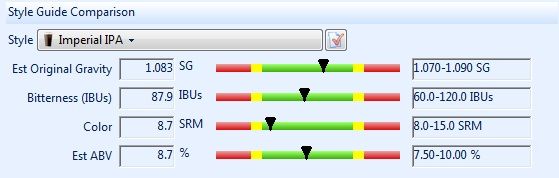
This is one of the best all-grain IPA recipes you can use.  Magnum as the primary bittering hop gives a soft bitterness that won't overpower, even with the high IBUs.  The Centennial is the star here, providing a dominant grapefruit flavor that works well with the light malts.  

Grain - 
15 lbs 2row
1lb Munich 20SRM
1.5lb crystal 20


Hops - 
1oz Magnum 60 mins
1oz centennial 30mins
1oz centennial 15 mins
1oz centennial 10 mins
2oz centennial 5 mins
1oz centennial 1 min


Yeast - 
Safale US-05 or Wyeast 1056

Assume 70% efficiency with this recipe and you will end up with an ABV% right in the middle of the target for an IIPA, 8.7%.  

You can download the Beersmith Recipe File.  This is a great way to put in the exact alpha acid % for your hops, and tweak the recipe for the efficiency of your system.

Wednesday, November 3, 2010

"Black IPA" or "How I could have Ruined my Ruination"

"A hot mess, I'm hot off the press, you yesterdays news, dude you just not fresh..." MURS "I'm innocent"

And powered by MURS let's talk about the hot new style everyone and their mom is brewing...Black IPA.

I asked the innocent question at work a month or so back of, " I want to brew. What should I make?" A chorus of "RUINATION!" came over the cube walls. Now don't get me wrong, I looove my Ruination clone, but I've already made it three times this year, and I wanted something a bit different...so I pulled up my Ruination recipe and attempted to ruin it.

My version of Ruination is typically very faithful to the original, with a big, but smooth bitterness from magnum, and lots of late centennial. Lately my centennial supply was low, so I've subbed in some amarillo for thbe dryhop, and some of the late additions. It changes it slightly, making it seem slightly sweeter. I'm still up in the air which way I prefer...grapfruit or the slight tangerineness with the amarillo...but I digress...

My typical Ruination recipe is 15lbs 2row, 1 lb munich 10l, 1lb crystal 20. (Note, double check recipe). What I did was simply swap out the munich for debittered carafa II, and change the crystal to a darker crystal 60. I wanted some roastiness, and maybe a bit more crystal flavor to come through in the final product.

Grain -
15 lbs 2row
1lb carafa II
1lb crystal 60

Hops -
0.5oz Magnum
1oz centennial 15mins
1oz amarillo 15 mins
1oz centennial 10 mins
1oz amarillo 10mins
1oz centennial 5 mins
1oz amarillo 5mins
2oz amarillo flameout
1oz centennial flameout

Yeast -
Us-05

You may be wondering why no dry hops...three reasons really. First of all, I typically just hop in the keg since my IPAs don't last long. This one isn't planned to be drank for a few weeks, so I didn't want to risk any grassy flavors. Secondly, I didn't have the muslin bag I needed for dryhopping. But most importantly, when I tasted it I actually loved that it had minimal hop aroma. if I didn't know it was a BIPA I would have thought it was just another stout, and then there is a huge wallop of hop flavor on that first sip. The roastiness melds close to perfectly with the citrusy hops flavors...even the hop-hating gf really liked it.

It is still not carbed, but the first impression is great. I had a couple small glasses last night, and I was really enjoying this. It won't replace the standard Ruination, but it will definitely be part of the rotation.

Sunday, May 17, 2009

Early Morning Amber

Decided to brew an American Amber Ale this morning, and got an early start to avoid the heat (100+).

I based the recipe on the great wiki here, which was incredibly helpful. I ended up getting slightly better efficiency than anticipated, and it looks like it will be slightly too high in the SG to be in style, but hopefully it will be a decent representation of a dark, crystally AAA.

I used the following ingredient list -

Grain -
9lbs Pale Malt
1lb Munich Malt
1lb Crystal 40 (I may have accidentally gotten 60 when I was at the LHBS)
1lb Crystal 80

Hop Schedule -
0.7oz Centennial First Wort Hop
0.6oz Centennial 20 minutes
0.2oz Centennial 5 minutes
o.5oz Centennial 0 minutes

Yeast -
Safale US-05

Mash -
153 F
1hr

Details -
SG - 1.062
IBUS - 35.5
SRM - 15.2

I'm going to ferment as close to 60F as possible, which will be fun with the 100F temps we're experiencing.

Edit - Fermentation has been more in the 70F range. I have been bested by the heat.

Update - June 1 2009
Did my first tasting, and measured the FG. Gravity was down to 1.011, which is slightly lower than expected, but still within range. There was not a lot of hop aroma, but the bitterness was about right. The beer was a little alcohol flavored, which I am attributing to the hotter fermentation temps. Hopefully a little time, cold and carbonation will make it less apparent.