Showing posts with label beer recipes. Show all posts

Sunday, February 10, 2013

Stove Top Centennial Pale Ale

Today was my first brew of the year, an all-centennial American Pale Ale.  My goal was to create a beer to showcase the centennial hops.  To do this I kept the grain bill simple, and kept all of the hop additions within the last 30 minutes.
My stove-top brewing setup

This was my first time doing BIAB.  I'll probably keep using it for 1-gallon batches, but for the 3-gallon batches I am going to find a different way, likely a 5-gallon cooler with a steel braid.  I was pleasantly surprised with the efficiency I had. It was better than I had gotten in the past, which I mostly think was due to the better crush on the grain.

The only down side to the brew was the non-siphoning auto siphon.  For some reason it wouldn't keep flowing, and I had use it like a hand pump.

I had forgotten how enjoyable brewing can be.  I've done group brews recently, but this was my first solo brew in over a year. I'm looking forward to brewing many test batches in the coming weeks/months, and getting feedback on the recipes from other people.

Recipe Targets -
MF DOOM is protecting my beer from the sun
OG - 1.052
FG - 1.011
IBUs - 37
ABV - 5.4
SRM - 9.4

Grain Bill -
5 pounds 2-row pale malt
1 pound Crystal 40

Hops -
0.25 oz Centennial - 30 minutes
0.25 oz Centennial - 20 minutes
0.25 oz Centennial - 15 minutes
0.25 oz Centennial - 10 minutes
0.5 oz Centennial - 5 minutes
0.5 oz Centennial - 1 minutes

Yeast - Safale US-05

This is going to be my new recipe testing method - 1-, or 3-gallon batches. I've always done full 5-gallon batches before, and the lag time on testing recipes was just too long.  Brewing 4-5 versions of a beer to perfect it resulted in a LOT of beer.  By the time the recipe would be perfected, I would be tired of the style.

Update 2/26 - I added gelatin to help this clear, and it had a great aroma from the fermenter.  I am planing to bottle this on 3/2.

Wednesday, February 6, 2013

British-style Ale Recipe Designing

I was reading in Tasting Beer: An Insider's Guide to the World's Greatest Drink tonight about brewers in late-1700s England replacing the brown malts in Porters with pale malt to improve efficiency.  Apparently some used burnt/candied sugars to darken their brews.  That would add to not only the darkness, but should add flavor as well.

The candi-sugar would have had a different taste and aroma than the brown malts it replaced.  These cadi-sugared beers would have had a flavor more like raisins or prunes. The old versions would have tasted more like chocolate or coffee.  Undoubtedly the darkest sugars used would have approximated some of the roasty characteristics of brown malt.
This got me to thinking about the beer recipe I've been creating.
PS - I did not drink these in one evening.

I want to brew an British-style ale, and the candi-sugar in the Porter story made me wonder what a brewer would do if they only had pale malt.  You would have to find tricks to make a beer look a certain way.  Things like using home-made dark candi-sugar in place of darker malts.

My starting recipe will be -

  • 8 pounds - Marris Otter
  • 1 pound - Candi Sugar (50SRM)
  • 1.25 oz - Northern Brewer (60 minutes)
  • 1 oz - East Kent Goldings (5 minutes)
  • Safale us-04
I hope this will get me a dry, moderately bitter beer.  There should be notes from the sugar that you normally only get from sweeter, bigger beers.  I will mash the MO at 154­­°, that should help the beer from finishing too low.

Targets - 


  • Original Gravity - 1.050
  • Final Gravity - 1.010
  • Color - 8.4 SRM
  • ABV - 5.3%
  • IBUs - 40

My test with this recipe is going to be the sugar.  I will replace the sugar with a darker variety each of the five times I brew this.  That way I can judge which sugar is the right color, and see how dark I need the sugar to get the color of a Porter.  I am going to make sugar for each batch, and make it darker each time.  I will follow the normal candi-sugar making method.

I am still figuring out exactly what the sugar should look like for each SRM.  I am hoping that I can simply shoot for soft-crack, hard-crack, clear-liquid, brown-liquid, and just short of the burnt-sugar stage.  The plan is to test out 50, 125, 250, 375, and 500 SRM versions of the sugar.  I hope I can get the 500 SRM sugar to match some of the dark malts, without having too much burnt flavor.

In a previous beer I was able to get very intense plum flavors, and dark coloring from caramelizing sugars, so this all should be possible.  The question I have is really one about taste.  Will the beers with the sugar still be in the style of the originals?  What impact did seeking better efficiency have on the beers of Britain in the late 18th century?

Tuesday, January 29, 2013

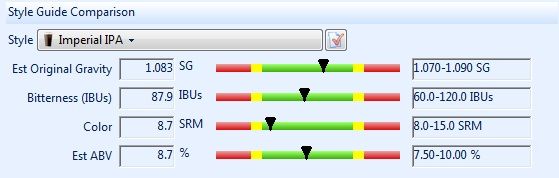
Centennial IPA

This is one of the best all-grain IPA recipes you can use.  Magnum as the primary bittering hop gives a soft bitterness that won't overpower, even with the high IBUs.  The Centennial is the star here, providing a dominant grapefruit flavor that works well with the light malts.  

Grain - 
15 lbs 2row
1lb Munich 20SRM
1.5lb crystal 20


Hops - 
1oz Magnum 60 mins
1oz centennial 30mins
1oz centennial 15 mins
1oz centennial 10 mins
2oz centennial 5 mins
1oz centennial 1 min


Yeast - 
Safale US-05 or Wyeast 1056

Assume 70% efficiency with this recipe and you will end up with an ABV% right in the middle of the target for an IIPA, 8.7%.  

You can download the Beersmith Recipe File.  This is a great way to put in the exact alpha acid % for your hops, and tweak the recipe for the efficiency of your system.

Wednesday, November 3, 2010

"Black IPA" or "How I could have Ruined my Ruination"

"A hot mess, I'm hot off the press, you yesterdays news, dude you just not fresh..." MURS "I'm innocent"

And powered by MURS let's talk about the hot new style everyone and their mom is brewing...Black IPA.

I asked the innocent question at work a month or so back of, " I want to brew. What should I make?" A chorus of "RUINATION!" came over the cube walls. Now don't get me wrong, I looove my Ruination clone, but I've already made it three times this year, and I wanted something a bit different...so I pulled up my Ruination recipe and attempted to ruin it.

My version of Ruination is typically very faithful to the original, with a big, but smooth bitterness from magnum, and lots of late centennial. Lately my centennial supply was low, so I've subbed in some amarillo for thbe dryhop, and some of the late additions. It changes it slightly, making it seem slightly sweeter. I'm still up in the air which way I prefer...grapfruit or the slight tangerineness with the amarillo...but I digress...

My typical Ruination recipe is 15lbs 2row, 1 lb munich 10l, 1lb crystal 20. (Note, double check recipe). What I did was simply swap out the munich for debittered carafa II, and change the crystal to a darker crystal 60. I wanted some roastiness, and maybe a bit more crystal flavor to come through in the final product.

Grain -
15 lbs 2row
1lb carafa II
1lb crystal 60

Hops -
0.5oz Magnum
1oz centennial 15mins
1oz amarillo 15 mins
1oz centennial 10 mins
1oz amarillo 10mins
1oz centennial 5 mins
1oz amarillo 5mins
2oz amarillo flameout
1oz centennial flameout

Yeast -
Us-05

You may be wondering why no dry hops...three reasons really. First of all, I typically just hop in the keg since my IPAs don't last long. This one isn't planned to be drank for a few weeks, so I didn't want to risk any grassy flavors. Secondly, I didn't have the muslin bag I needed for dryhopping. But most importantly, when I tasted it I actually loved that it had minimal hop aroma. if I didn't know it was a BIPA I would have thought it was just another stout, and then there is a huge wallop of hop flavor on that first sip. The roastiness melds close to perfectly with the citrusy hops flavors...even the hop-hating gf really liked it.

It is still not carbed, but the first impression is great. I had a couple small glasses last night, and I was really enjoying this. It won't replace the standard Ruination, but it will definitely be part of the rotation.

Sunday, May 17, 2009

Early Morning Amber

Decided to brew an American Amber Ale this morning, and got an early start to avoid the heat (100+).

I based the recipe on the great wiki here, which was incredibly helpful. I ended up getting slightly better efficiency than anticipated, and it looks like it will be slightly too high in the SG to be in style, but hopefully it will be a decent representation of a dark, crystally AAA.

I used the following ingredient list -

Grain -
9lbs Pale Malt
1lb Munich Malt
1lb Crystal 40 (I may have accidentally gotten 60 when I was at the LHBS)
1lb Crystal 80

Hop Schedule -
0.7oz Centennial First Wort Hop
0.6oz Centennial 20 minutes
0.2oz Centennial 5 minutes
o.5oz Centennial 0 minutes

Yeast -
Safale US-05

Mash -
153 F
1hr

Details -
SG - 1.062
IBUS - 35.5
SRM - 15.2

I'm going to ferment as close to 60F as possible, which will be fun with the 100F temps we're experiencing.

Edit - Fermentation has been more in the 70F range. I have been bested by the heat.

Update - June 1 2009
Did my first tasting, and measured the FG. Gravity was down to 1.011, which is slightly lower than expected, but still within range. There was not a lot of hop aroma, but the bitterness was about right. The beer was a little alcohol flavored, which I am attributing to the hotter fermentation temps. Hopefully a little time, cold and carbonation will make it less apparent.